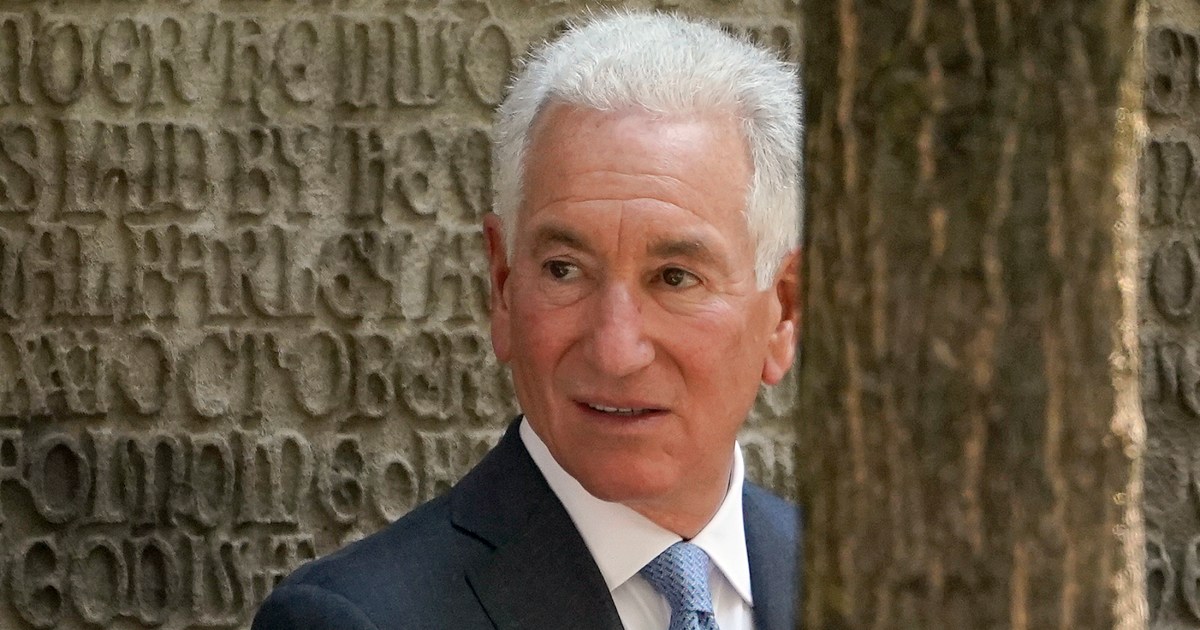
France Restricts Charles Kushner's Access Amid Escalating Diplomatic Row
In a significant escalation of diplomatic tensions, France has moved to restrict the access of U.S. Ambassador to France, Charles Kushner, signaling a serious breach in traditional Franco-American relations. French Foreign Minister Jean-Noël Barrot issued a stern warning, indicating that Ambassador Kushner's ability to "exercise his mission" in the country would be severely curtailed unless he responded to a summons for a crucial meeting. This unprecedented move underscores France's profound displeasure with recent statements made by U.S. bureaus regarding internal French affairs, particularly a tragic incident involving a far-right activist.
The diplomatic firestorm centers around comments posted on social media by the U.S. State Department’s Counterterrorism Bureau and subsequently amplified by the U.S. Embassy in Paris. These posts addressed the death of Quentin Deranque, a far-right activist who succumbed to brain injuries earlier this month following a reported clash between far-right and far-left groups in Lyon. The U.S. statements controversially asserted that "violent radical leftism is on the rise and its role in Quentin Deranque’s death demonstrates the threat it poses to public safety," adding that the U.S. would "continue to monitor the situation and expect to see the perpetrators of violence brought to justice."
French authorities, led by Minister Barrot, swiftly and vehemently rejected these assertions, viewing them as an unacceptable intrusion into France's domestic political landscape and an "instrumentalization of this tragedy... for political ends." Barrot's rebuke was sharp: "We have no lessons to learn, particularly on the issue of violence, from the international reactionary movement." The demand for Charles Kushner to present himself at the Quai d'Orsay, the seat of the French Foreign Ministry, is not merely a formality but a direct challenge, designed to elicit immediate explanations and a potential recalibration of U.S. diplomatic conduct on French soil.
The Core of the Dispute: Sovereignty, Protocol, and Social Media
At the heart of this diplomatic impasse is a fundamental disagreement over sovereignty and the appropriate conduct of foreign diplomatic missions. France perceives the U.S. statements regarding Quentin Deranque's death as a direct challenge to its internal justice system and a politicized interpretation of a sensitive domestic issue. For a foreign government, particularly through its embassy, to comment on such a matter, especially attributing blame to a specific political ideology within the host country, is seen as a significant overstep. It suggests a lack of trust in French institutions to investigate and resolve the incident impartially.
The use of social media further complicates the matter. In the age of instant communication, diplomatic statements can quickly reach a wide audience, often without the nuanced context provided by traditional diplomatic channels. What might be perceived as monitoring or concern by one nation can be interpreted as interference or condemnation by another. The French government's response highlights a growing frustration with what it views as an "international reactionary movement" attempting to dictate narratives or exert influence over its internal affairs. For a seasoned diplomat, understanding the fine line between observation and intervention is paramount, a line that France believes Ambassador Kushner and the U.S. State Department have repeatedly crossed.
As French Foreign Minister Jean-Noël Barrot articulated, summoning an ambassador is a standard diplomatic tool "when explanations need to be made." However, the subsequent warning that Kushner would not "regain access to members of the French government" until these explanations are satisfactorily provided elevates the situation significantly. This isn't just a request for a meeting; it's a threat of diplomatic isolation, a serious measure that can severely hamper an ambassador's ability to perform their duties effectively and represent their nation's interests. To delve deeper into the initial summons, you can read more about US Ambassador Charles Kushner Summoned by France Over Social Media Controversy.
A Pattern of Controversy: Previous Encounters and Kushner's Nomination
This isn't the first time Charles Kushner, father of Donald Trump's son-in-law Jared Kushner, has found himself in France's diplomatic crosshairs. Just last year, France summoned Kushner after he reportedly accused the French government of "fuelling antisemitism" through its criticisms of Israel. That earlier incident, which the U.S. State Department also backed, was strongly refuted by the French Foreign Ministry. Compounding the issue then was Kushner's reported decision to send the U.S. embassy's charge d’affaires in his place, rather than appearing himself—a move that was likely interpreted as a further slight and a disregard for diplomatic protocol.
Charles Kushner's appointment as U.S. Ambassador to France, announced by Donald Trump in November 2024 following his presidential election victory, has been considered controversial from the outset. Kushner's past includes a federal conviction for tax evasion, illegal campaign contributions, and witness tampering, for which he served time in prison before being pardoned by then-President Trump in 2020. While a presidential pardon legally restores rights, some diplomatic circles have privately questioned the appropriateness of such a contentious individual representing the United States in a key allied nation like France, especially given the delicate nature of international relations. These past controversies, coupled with the recurring diplomatic spats, contribute to a narrative of strained relations and perceived disrespect for established diplomatic norms.
The cumulative effect of these incidents suggests a fundamental misunderstanding or disregard for the unwritten rules of diplomacy, particularly regarding a host nation's sovereignty and the expected decorum of a foreign envoy. For further insights into these ongoing issues, consider reading Charles Kushner's Diplomatic Troubles: Why France is Summoning the US Ambassador.
The Role of an Ambassador: Beyond Rhetoric and Towards Reconciliation
The role of an ambassador is multifaceted, encompassing representation, negotiation, reporting, and promotion of friendly relations. Crucially, an ambassador is expected to serve as a bridge between nations, facilitating communication and understanding, not creating chasms. When an ambassador's actions, or the statements of their government, are seen to interfere with a host country's internal affairs, it fundamentally undermines this delicate balance.
France’s Foreign Ministry, while firm, has deliberately left a path open for reconciliation. Their statement noted, "It remains, of course, possible for Ambassador Charles Kushner to carry out his duties and present himself at the Quai d’Orsay, so that we may hold the diplomatic discussions needed to smooth over the irritants that can inevitably arise in a friendship spanning 250 years." This olive branch indicates France's desire to resolve the situation through dialogue, provided that the U.S. demonstrates a willingness to engage respectfully and acknowledge French concerns.
Practical Steps for Mending Ties:
- Direct Engagement: Ambassador Kushner must personally meet with Foreign Minister Barrot to provide the requested explanations and express understanding for France’s perspective.
- Respect for Sovereignty: The U.S. Embassy and State Department should issue clarifying statements or refrain from commenting on sensitive French domestic issues, particularly those under active investigation.
- Reinforce Diplomatic Channels: Prioritize private, formal diplomatic communications over public social media pronouncements for sensitive matters.
- Cultural Sensitivity Training: For all embassy staff, reinforcing an understanding of French political sensitivities and historical context can prevent future missteps.
- Reaffirm Shared Values: Both nations should emphasize the broader, long-standing alliance and common interests that transcend these temporary disputes.
The Franco-American relationship, built on centuries of shared history and democratic values, is robust but not impervious to strain. Incidents like these, particularly when they involve perceived disrespect or interference, can chip away at the foundation of trust. For the U.S., ensuring its diplomatic representatives adhere strictly to protocols of non-interference and mutual respect is vital for maintaining alliances and projecting an image of reliable international partnership.
Conclusion
The restriction of access for U.S. Ambassador Charles Kushner by France marks a significant low point in recent Franco-American diplomacy. Triggered by U.S. comments on a tragic domestic incident and exacerbated by past controversies, this diplomatic row highlights the critical importance of respecting national sovereignty and adhering to established diplomatic protocols. While France has clearly drawn a line, it has also extended an invitation for dialogue, underscoring the enduring value of their bilateral relationship. The path forward demands humility, direct engagement, and a renewed commitment from the U.S. to conduct its diplomacy in a manner that upholds mutual respect and avoids further instrumentalization of sensitive national issues. The resolution of this standoff will be a crucial test of diplomatic acumen and a determinant of the future tone of relations between these two key global allies.